


Deployment Case Studies – Multi-Architecture Integration & Use Cases
NSE Intelligent Customer Service – Multiple Architecture Integrations (Genesys / Avaya) & Application Scenarios
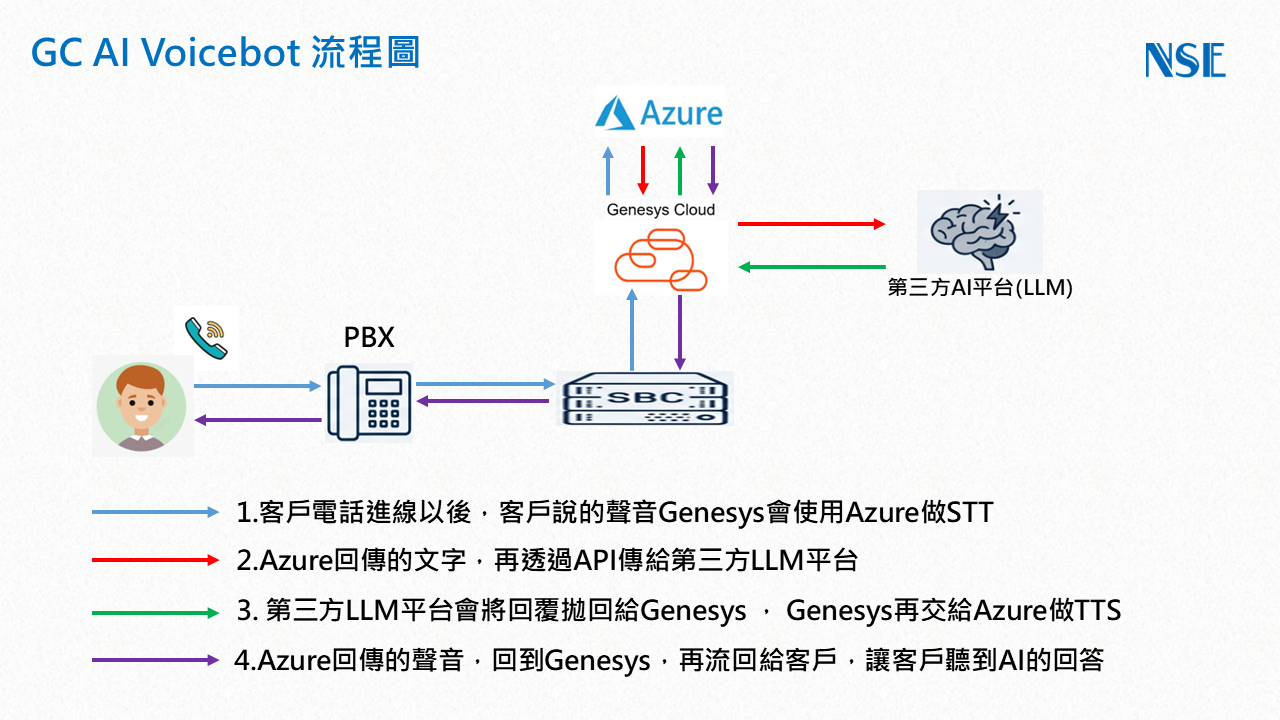
1. Genesys Cloud Integration with AI Voicebot – Scenario 1
Once a call is established (supports both inbound and outbound calls), the customer's voice is converted into text through Azure speech recognition integrated within Genesys Cloud. A large language model then understands the request and generates a response, which is finally converted back into natural speech by Azure and delivered to the customer.
Since this architecture directly uses the existing Azure ASR and TTS already integrated in Genesys Cloud, no additional voice services or duplicate charges are required. While maintaining high accuracy and stability, it significantly reduces the overall deployment and operational cost of voice AI. It is suitable for applications such as smart IVR, self-service inquiries, and automated outbound notifications.
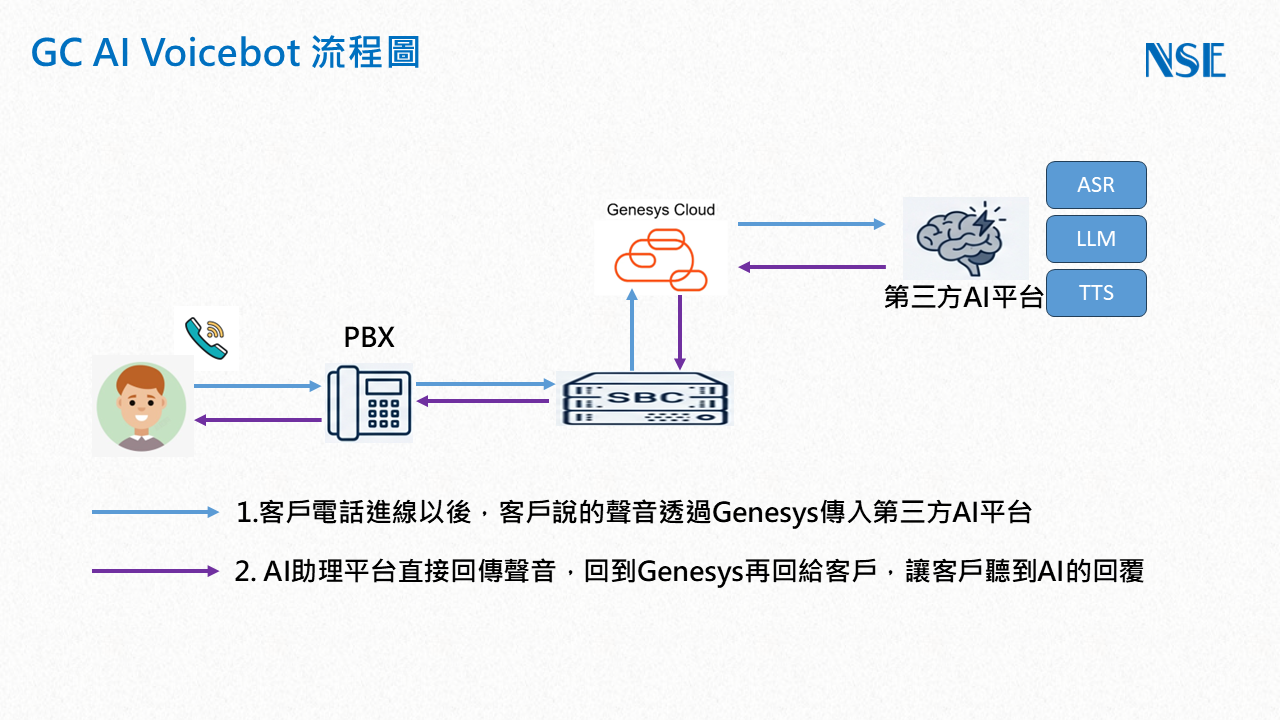
2. Genesys Cloud Integration with AI Voicebot – Scenario 2
In this architecture, once the call is established (both inbound and outbound), voice content is sent directly to the AI platform for processing. The AI understands the conversation in real time and responds to the customer using synthesized speech. Because the process has fewer conversion steps, the response speed is faster.
Since ASR, LLM, and TTS can freely select different vendors and models, enterprises can combine the most suitable AI technologies according to language, industry, or budget requirements. It can also be integrated with RAG technology, enabling AI to retrieve accurate answers from enterprise knowledge bases or internal documents in real time, ensuring responses are not only fluent but also aligned with company knowledge and policies.
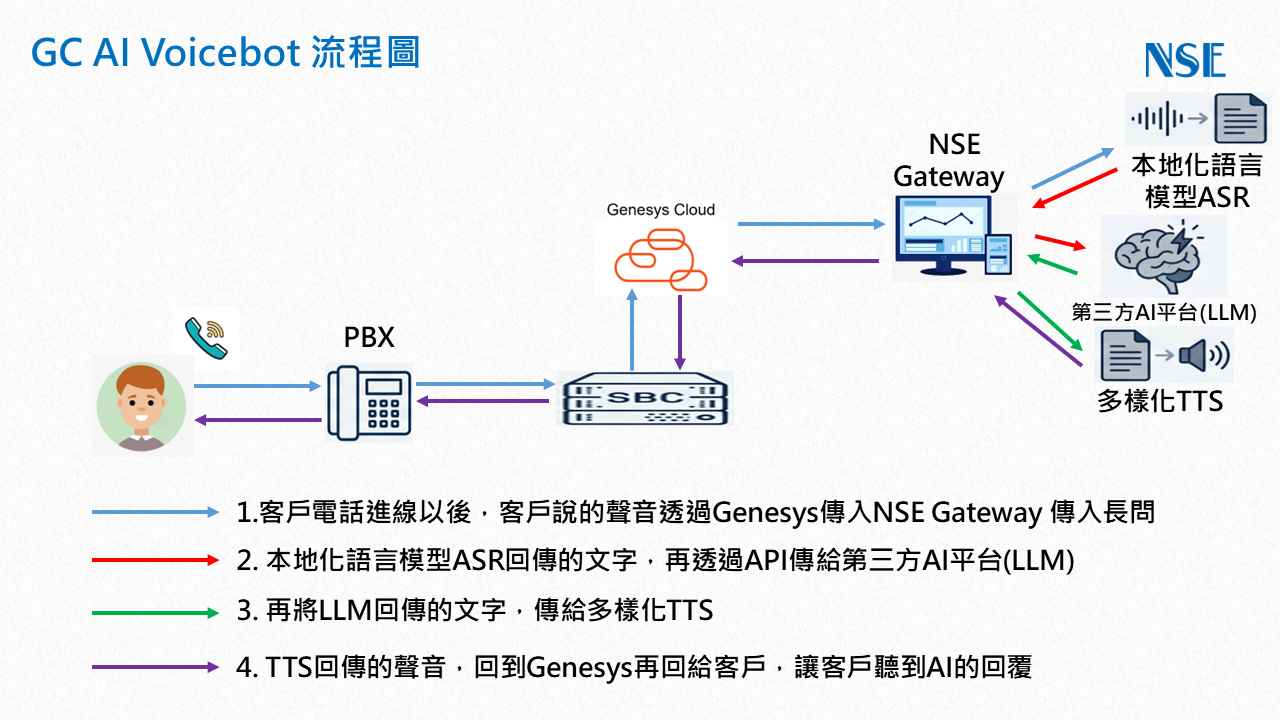
3. Genesys Cloud Integration with AI Voicebot – Scenario 3
Enterprises can first route call audio (both inbound and outbound) through the NSE Gateway to a local speech recognition model. This allows accurate recognition of Mandarin, Taiwanese, or Hakka. The recognized text is then processed by a large language model to understand intent, and finally converted into speech using a freely selected TTS engine to provide the most suitable voice response.
This architecture frees enterprises from relying on a single cloud service provider and allows them to combine AI modules according to language, accent, brand voice, and regulatory or security requirements. This enables organizations to build a highly customized AI voice customer service system that aligns with their brand identity and local usage scenarios while maintaining privacy and data security.
Comparison of Three Voicebot Integration Approaches for Genesys Cloud
| Comparison Item | Scenario 1 | Scenario 2 | Scenario 3 |
| Voice Customization Level | Limited to built-in Azure voices | Medium to high, depending on the AI platform | Highest, including brand voice and special accents |
| Supported Languages / Dialects | Standard Mandarin, English | Standard Mandarin, English | Taiwanese, Hakka, mixed languages |
| Key Advantages | Lowest cost, fastest deployment | Flexible selection based on needs | Highly customizable |
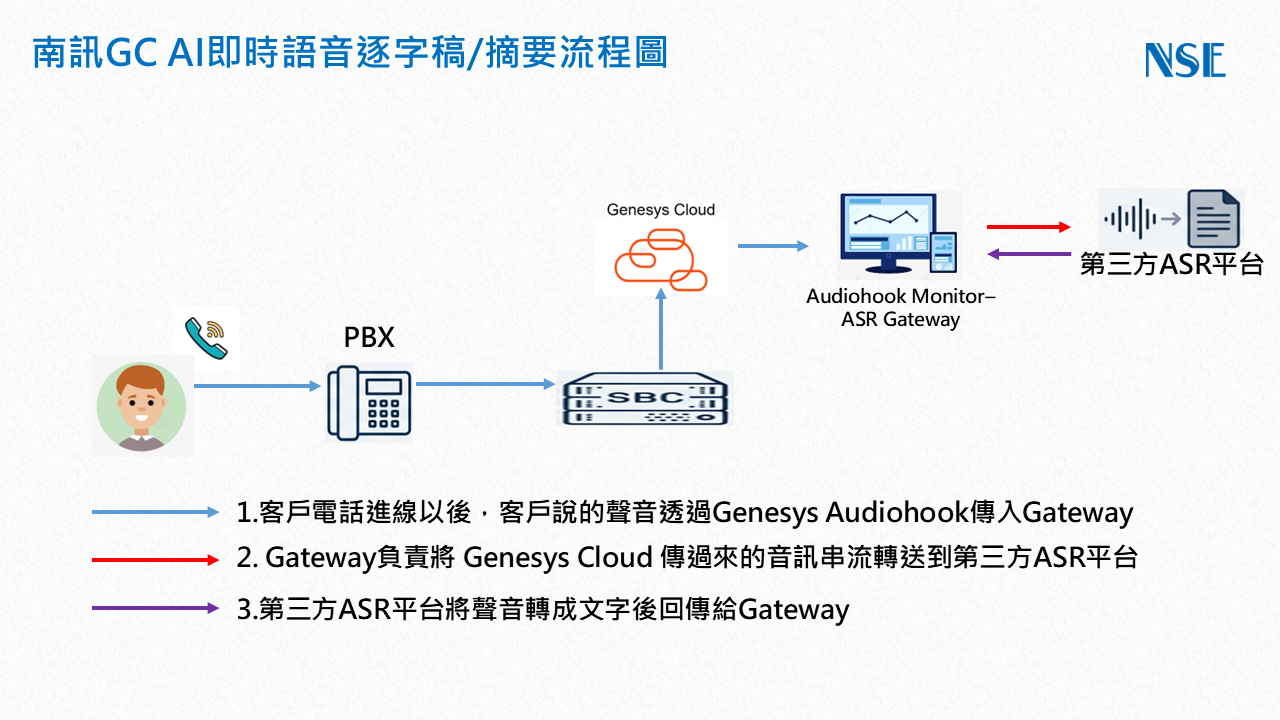
4. Genesys Cloud + AI for Real-time Call Transcripts and Call Summaries
Each call's audio is transmitted from Genesys Cloud to the ASR Gateway in real time, where speech recognition converts it into text. Enterprises can therefore view live transcripts during the conversation, and after the call ends, AI automatically generates key summaries (Auto Summary). This transforms traditional recording systems from simple data storage into searchable, analyzable, and auditable digital assets, helping managers better understand interactions between customers and agents.
5. Genesys Cloud Integration with AI Copilot for Real-time Agent Assistance
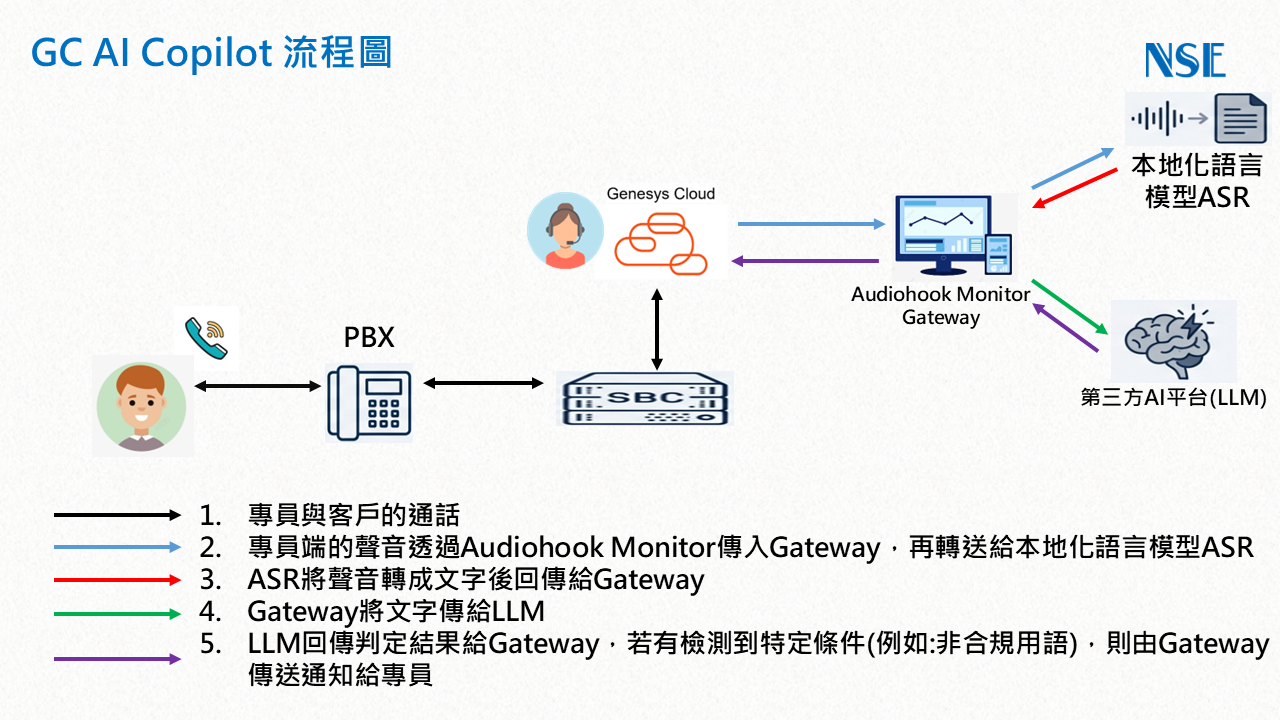
During conversations between agents and customers, voice is converted into text in real time and analyzed by AI. The system can detect non-compliant language, medium to high-risk scenarios, or key sales signals, and immediately alert the agent. At the same time, AI can provide relevant product information, conversation suggestions, and key explanations based on the ongoing dialogue.
This allows AI to function not only as a post-call audit tool but also as a real-time risk management and sales assistant during the call. Every agent effectively has an intelligent real-time coach, helping enterprises reduce risks and improve conversion rates.
6. Avaya EP Integration with On-premise / Cloud AI – Voicebot
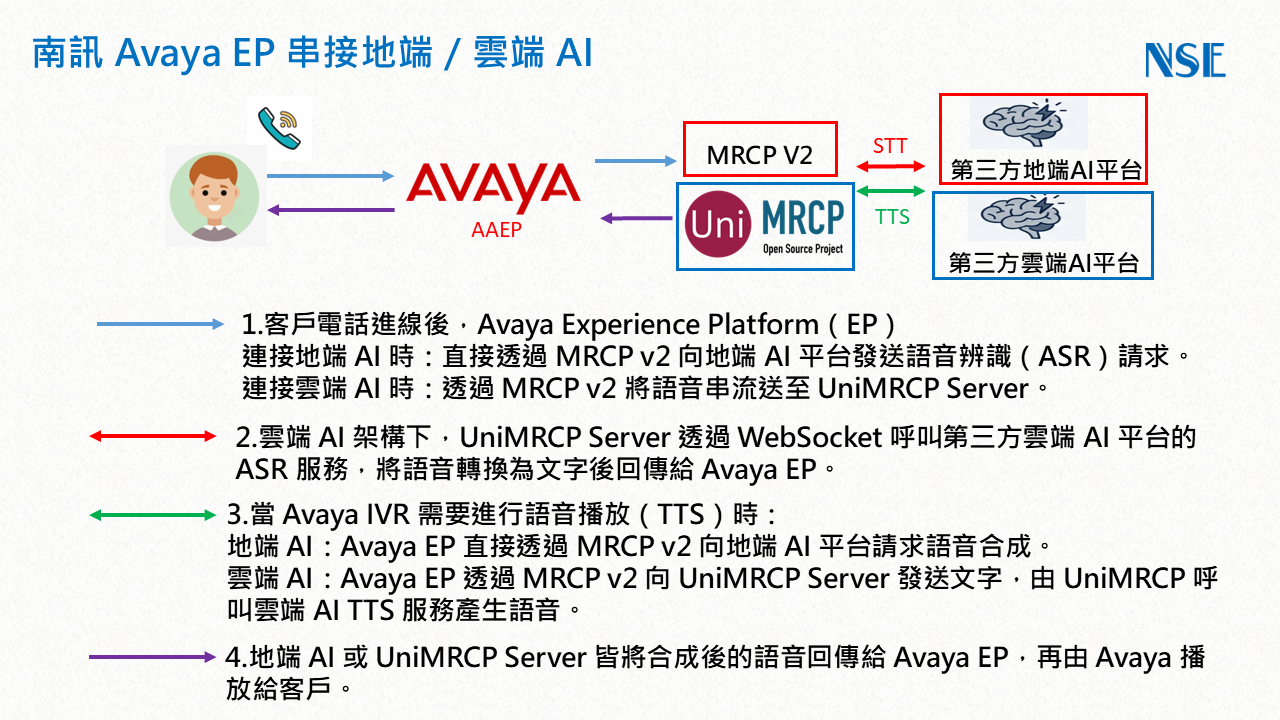
- Through Avaya EP combined with UniMRCP, existing Avaya IVR systems can simultaneously support on-premise and cloud-based third-party AI voice services.
- On-premise AI can be integrated directly through MRCP v2 in Avaya EP, while cloud AI services are connected via UniMRCP for protocol integration.
This architecture enables enterprises to introduce AI speech recognition (ASR) and text-to-speech (TTS) capabilities without replacing their existing telephony or IVR systems, allowing organizations to gradually upgrade to a next-generation AI voice service platform with high scalability.
@Why Choose NSE?
- 45 years of enterprise communication integration experience, with deep understanding of real-world contact center operations rather than focusing solely on AI models.
- Designed with enterprise-grade high availability and stability to ensure uninterrupted operations.
- Helps enterprises build AI architectures that can evolve over time, making intelligent customer service a strategic asset.
- Supports integration with existing Genesys Cloud and Avaya environments, protecting prior investments.
- Supports hybrid deployment (on-premise and cloud) to balance security, compliance, and enterprise data sovereignty.
- Extends existing IVR workflows and enables gradual AI adoption without requiring a full system overhaul.
- Click here to learn more about NSE Genesys Cloud - Omnichannel Cloud Customer Service System
- Click here to learn more about NSE Avaya CC Customer Experience Platform
- Click here to learn more about NSE NICE RPA

