


Text-to-Speech (TTS)
NSE - Text to Speech (TTS)
Text-to-Speech (TTS) is also known as speech synthesis technology. As the name suggests, it is a technology that converts written text into spoken audio output.
Early TTS technologies mainly relied on concatenating pre-recorded voice segments or mechanically simulating human pronunciation. The resulting voices often sounded rigid and unnatural, leading to a high call hang-up rate. Modern TTS uses deep neural networks and other advanced technologies to rapidly generate speech from scratch, producing more natural sound quality and intonation that better meet customer expectations and needs.
@NSE TTS Customization Examples
Mandarin 1
Mandarin 2
Mandarin 3
Taiwanese (Hokkien)
Hakka
@Common Applications of NSE TTS
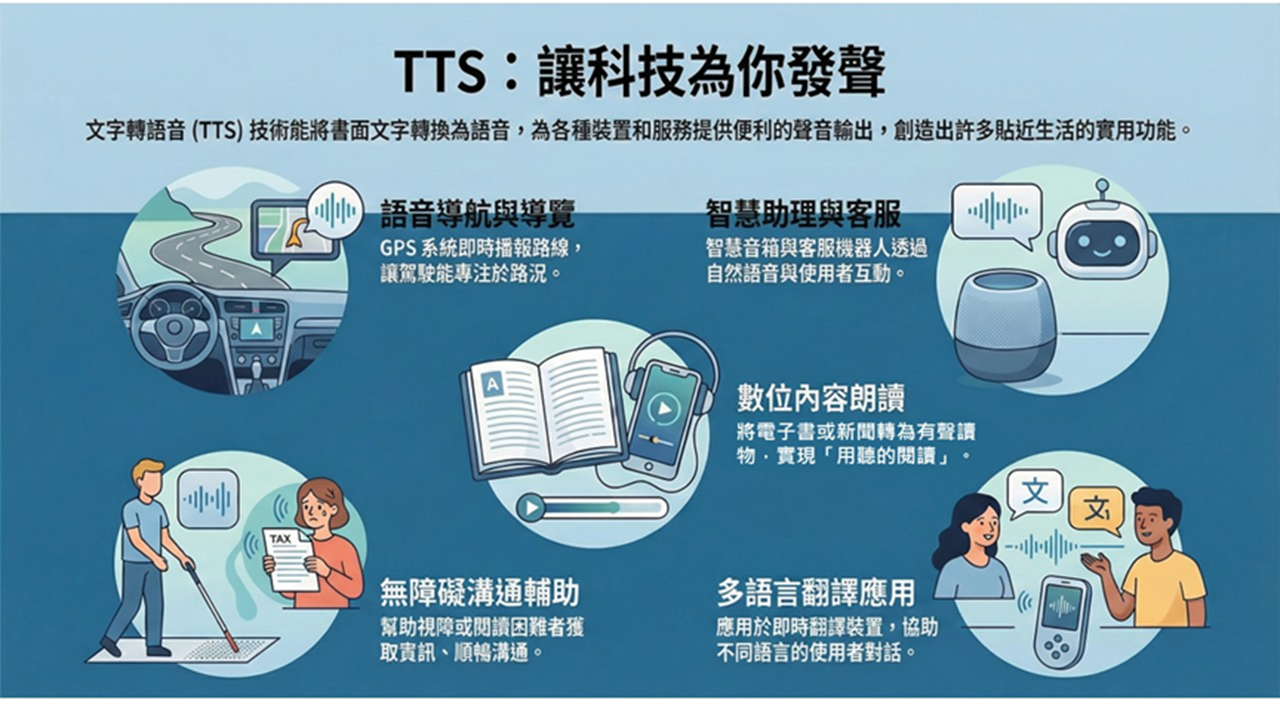 TTS creates application value in various scenarios:
| Voice Guidance & Navigation | In vehicle navigation systems or public guidance services in smart cities, TTS automatically converts map information or guidance text into spoken announcements. For example, GPS navigation voice prompts are generated in real time by TTS, allowing drivers to focus on the road without needing to look at the screen. |
| Smart Assistants & Voice Customer Service | Various digital assistants and customer service robots widely use TTS to interact with users. For example, smart speakers use synthesized speech to answer questions, while customer service chatbots use TTS to provide information or respond to callers. High-quality TTS voices make responses sound more natural and friendly, improving user satisfaction. |
| Digital Content Reading & Entertainment | TTS can automatically read aloud various types of written content, making it convenient for people to access information when they cannot look at a screen. For example, users can listen to news reports, audiobooks, or have their phone read messages while jogging. Many audiobook platforms and reading applications include built-in TTS features that convert text into spoken audio in real time. |
| Accessibility & Assistive Communication | For people with visual impairments or reading difficulties, TTS is an important assistive tool. It allows computers and mobile devices to read interface text or web content aloud, helping users access information without being limited by reading ability. In addition, people with speech impairments can input text and let TTS speak for them, enabling smoother communication. Therefore, TTS technology is also widely used in special education and medical rehabilitation. |
| International & Multilingual Applications | TTS supports multiple languages and accents, making it a powerful tool for cross-language communication. For example, real-time translation devices first convert spoken language into text, translate it into another language, and then use TTS to read out the translated result. Tourist attractions often use multilingual TTS for audio guides, and language learning tools use TTS to demonstrate pronunciation. |
@Why Choose NSE?
- Integrates multiple mainstream speech engines to create customized voice applications tailored to your needs.
- Supports multilingual and multi-dialect voice interaction to enhance customer service automation.
- Seamless integration with existing contact centers and call platforms, supporting high-concurrency operations.
- Combines speech recognition and large language model technologies to create conversational AI customer service and voice assistants.
- Designs IVR navigation logic according to enterprise workflows to optimize user experience.
- Supports branded voice tuning, allowing adjustment of voice tone and emotional parameters.
- Applicable to contact centers, voice bots, websites, apps, and internal enterprise systems.
- Click here to learn more about NSE Genesys Cloud - Omnichannel Cloud Customer Service System
- Click here to learn more about NSE Avaya CC Customer Experience Platform
- Click here to learn more about NSE Verint Recording

