


Speech-to-Text (ASR/STT)
NSE – Speech Recognition (ASR/STT)
Automatic Speech Recognition (ASR), also known as Speech-to-Text (STT), enables computers to “understand” human speech and convert it into text. Its core principle uses algorithms and machine learning models to analyze audio signals and identify the textual representation of speech features.
With breakthroughs in deep learning, modern speech recognition accuracy has significantly improved, even understanding different accents and dialects, and maintaining high accuracy in noisy environments. This technology has become a key bridge for human-computer interaction, widely applied in smart assistants, voice input, customer service systems, and is rapidly transforming our daily life and business models.
@ Common Applications of ASR/STT
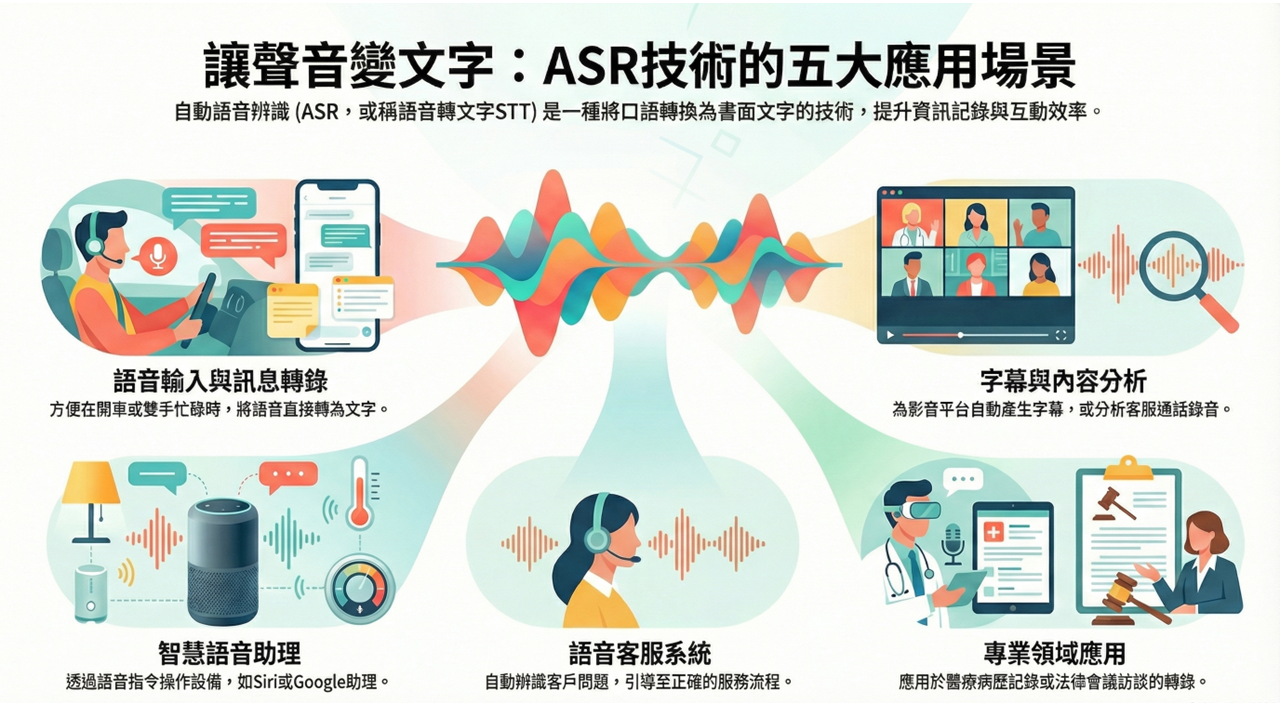
| Voice Input and Message Transcription | Use ASR to directly convert spoken content into text. For example, mobile voice input, automatic transcription of meeting recordings, etc., which allows users to record messages while driving or when hands are busy. This greatly enhances convenience for text recording during busy times. |
| Smart Voice Assistants | Smart assistants like Apple Siri, Google Assistant, and Amazon Alexa use ASR to understand user voice commands. Users can ask for weather updates, set alarms, or play music verbally, and ASR converts these voice commands into text for the system to process. |
| Voice Customer Service Systems | Automated voice response (IVR) or voice bots in call centers use ASR to recognize caller requests. For instance, telecom self-service systems leverage ASR to understand customer needs and guide them to the appropriate service flow, making traditional keypad-based phone menus more intuitive. |
| Subtitles and Content Analysis | Many video platforms automatically generate subtitles using ASR to transcribe speakers’ voices in real-time. Companies also use ASR to transcribe customer service calls for analysis and recordkeeping. This saves manual work and makes voice data searchable and analyzable. |
| Professional Applications |
In healthcare, doctors can use voice input for medical records, and ASR converts dictation into text, improving efficiency and reducing writing time. In legal practice, speech transcription is used to organize meeting minutes or interview content. These applications highlight the convenience ASR brings across industries. |
@ NSE ASR/STT Application DEMO
@ Why Choose NSE ASR/STT?
- Supports multilingual mixed recognition, domain-specific model customization, offline and embedded applications.
- Provides overall assessment and planning based on language type, usage scenario, recognition accuracy, system architecture, and security requirements.
- Seamlessly integrates with existing business processes and information systems for maximum efficiency.
- Integration experience with international mainstream customer service platforms such as Genesys and Avaya.
- Supports natural voice interaction in IVR applications for real-time intent recognition and automated services.
- Provides an end-to-end architecture from voice capture, speech recognition, semantic understanding, to system response.
- Supports meeting transcription and live captions, bilingual customer service, multi-engine architecture, and on-premises deployment.
- Helps enterprises enhance service efficiency, protect privacy, and strengthen competitiveness through voice technology.
- Click here to learn more about NSE Genesys Cloud - Omnichannel Cloud Customer Service System
- Click here to learn more about NSE Avaya IP / Digital / Conference Phones
- Click here to learn more about NSE Yealink IP Phones

